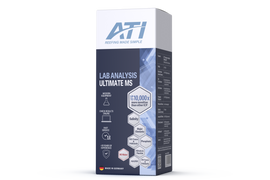

ATI Laboratory Analysis Ultimate combines ICP-OES and ICP-MS to give you the highest accuracy in all areas and our most comprehensive analysis. With the ATI Laboratory Analysis Ultimate you benefit from numerous Advantages:
- Higher accuracy and significantly lower detection limits down to the ultra-trace range through ICP-MS (e.g. manganese, selenium, vanadium, arsenic etc.) - Detection element-specific down to 0.001 µg/l possible (cf. detection limit ICP-OES 0.5 - 3.5 µg/l depending on element)
- Earlier detection of pollutants: Enables faster reactions to avoid problems
- Expanded element portfolio (so-called MS trace elements* and MS contaminants*): Rubidium, neodymium, zirconium, etc.
- Double validated results: Many values are measured with both ICP-OES and ICP-MS and checked for plausibility. Measurement errors can therefore be ruled out even more reliably
- Expanded element portfolio (so-called MS trace elements* and MS impurities*): rubidium, neodymium, zirconium and many more
- The most suitable measurement method is used for each water value - e.g. bulk elements with ICP-OES, trace and ultra-trace elements with ICP-MS.
Depending on the version of the test, the analysis values include the following:
- Salinity (salt content in PSU)
- KH (=carbonate hardness / alkalinity)
- Nutrients: nitrogen / nitrate, phosphorus / phosphate
- Quantity elements: Sodium, calcium, chloride, magnesium, sulphur, potassium, bromine, strontium, boron, fluorine
- OES trace elements: Barium, beryllium, iron, iodine, lithium, molybdenum, silver, silicon
- OES pollutants: aluminum, antimony, bismuth, cadmium, lanthanum, thallium, titanium, tungsten
- MS trace elements*: Arsenic, chromium, cobalt, copper, manganese, nickel, rubidium, selenium, vanadium, zinc, tin
- MS pollutants*: Lead, neodymium, niobium, zirconium, indium, germanium, gallium, mercury, tellurium
| Parameter | ICP-OES Standard | ICP-OES Pro | ICP-MS Ultimate |
| Salinity | ✓ ICP-OES | ✓ ICP-OES | ✓ ICP-OES |
| Bulk elements (except fluoride) | ✓ ICP-OES (high accuracy) | ✓ ICP-OES (high accuracy) | ✓ ICP-OES (high accuracy) |
| OES trace elements | ✓ ICP-OES (medium detection limits) | ✓ ICP-OES (medium detection limits) | ✓✓ ICP-MS (extremely low detection limits down to ultra-trace levels) & ICP-OES |
| OES contaminants | ✓ ICP-OES (medium detection limits) | ✓ ICP-OES (medium detection limits) | ✓✓ ICP-MS (extremely low detection limits down to ultra-trace levels) & ICP-OES |
| Phosphorus/Phosphate | ✓ ICP-OES high accuracy) | ✓ ICP-OES high accuracy) | ✓ ICP-OES (high accuracy) |
| Nitrate and Fluoride | X | ✓ Ionenchromatographie | ✓ Ion Chromatography |
| KH |
X | ✓ Titration | ✓ Titration |
|
Reverse osmosis water analysis |
X | ✓ ICP-OES high accuracy) | ✓ ICP-OES (high accuracy) |
| MS trace elements* | X | X | ✓✓ ICP-MS (extremely low detection limits down to ultra-trace levels) |
| MS contaminants* | X | X | ✓✓ ICP-MS (extremely low detection limits down to ultra-trace levels) |
| Ideal for: | Basic analysis for budget-conscious users | Comprehensive analysis with all key parameters | Full analysis including contaminants and ultra-trace elements |